Here is how our seeds are doing so far:
| 50% of seeds are sprouted on the 5th day | 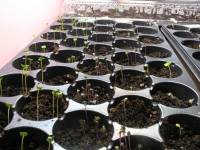 |
| On the 13th day, true leaves appear. |  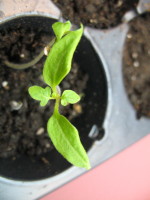 |

Here is how our seeds are doing so far:
| 50% of seeds are sprouted on the 5th day | |
| On the 13th day, true leaves appear. | |
It is April 1 and time to start the seedlings. First we start planting marigold, tomato, cabbage and cauliflower.
Here are the steps:
First we fill the plug sheets with soil. It is a blend of peat moss, perlite and compost. SFG recommends using vermiculite over perlite. I am going to use vermiculite in the outdoor garden but for now, we will use whatever is on hand.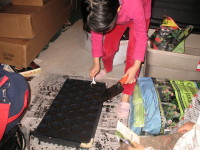 . .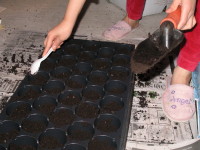 |
Next, we apply a mist to the soil. We don’t want to soak it but wet the surface lightly.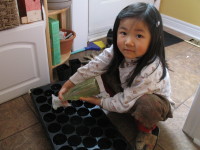 |
Then we drop the tiny seeds into each hole.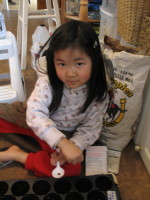 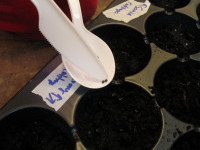 |
We then place the trays on our small seedling station and wait..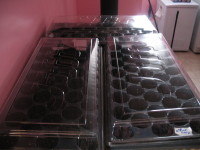 |
If the reader goes back to this post about extending the season, it is now time to give a report.
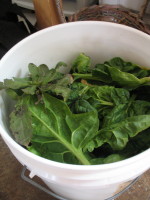
Here we just have our first fresh spinach of the season. Note that the spinach were sowed last fall and the leaves die back during winter but as soon as the weather warms up, they start to grow again.
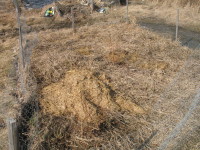
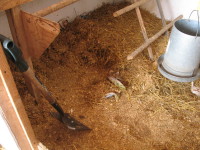
The weather is warmer now during daytime, although sometimes it freezes at night. Since I have no work at the moment, I start to shovel the poultry manure bedding in the coop and spread them on several places: the blueberry patch, the would-be sunflower spot and around the apple trees. Since I use deep-bedding manure system, the manure has been composted right in the coop for 10 months now, so they should be safe to use.
On the other hand, I am starting to read the All New Square Foot Gardening book again to refresh my mind. I have bought plug sheets this year to start the seedlings and I will use Pro-Mix for starting soil. So far we have started green onions.
 |
 |
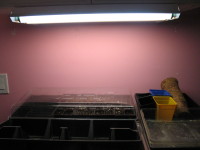
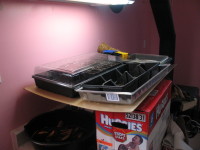
We have started some green onions seeds indoors. Ideally we can have a spot for a seed rack, with a fluorescent light mounted on each rack. However, living in a small house we don’t have that luxury. So I find a spot in the basement where I can put 3 seed trays underneath a kitchen cabinet. I installed a fluorescent fixture that uses 2 T12 tube. One cool white and one soft white. It would be better if you can use T8 tubes because the light is more equally distributed.
I use 2 boxes to hold a piece of board which in turn holds the 3 seed trays. Once the seeds sprouted, the light will be turned on for 12 hours a day. It is exciting to see how this will turn out.
 |
 |
I am going to list the seeds I order this year so that the readers and I can keep track of the progress, if I ever get to plant them 🙂
From Mapple Farm:
My goal is to grow these plants with the Squre Foot Gardening and see if I can indeed grow more food with less land and labour.
We came back from Mission Conference in PA last week. It was 0°C most of the time and no snow. When we were back to Ontario, we got snow and -20°C at night most of the week. Anyway, it is time to order seeds again. I really want to have a seed starting rack indoor but with 7 ppl in the house, finding space is always a challenge. However, rather than buying packets of seeds, I am going to buy them in bulk, at least some of them. I try to buy heirloom and open-pollinated varities, but sometimes hybrid grow better with less disease. Of course, we stay away from GMO seeds. Buying seeds in bulk save money but you would have to store the remaining seeds properly.
1. Put the seeds in plastic zipper bag of the right size. Make sure the seeds are dry.
2. Put a label with the date and name of seed on the zipper bag.
3. Put several bags in an air-tight jar. A canning jar is good.
4. Put a bag of silica gel into the jar. This will absorb excess moisture.
5. Put the jar in the refridgerator. Make sure it is air-tight.
6. when it comes to next year’s planting time do a seed starting test for germination rate.
We are going to a mission conference in PA for a couple of days so we have decided to butcher our layers. I have arranged an arbattoir to process them 1 month ago. So I picked up the crates the night before and brought them to the plant last Thursday. I got a call Friday night saying they have forgotten that I was sending the hens and thus there were no inspector and no butchering. They asked me to take them back and rearranged another date. Well, my neighbour has to work that night and so I don’t have the trailer. I replied back saying I couldn’t make it and asked them to dispose the hens. So it was a waste, no free-range, farm fresh stew hens for us. I hope this year when we are going to raise 50 -100 broilers this won’t happen again.
I am planning to grow sweet potatoes next year. This is an easy-to-grow and nutruious plant. If anyone is interested, please email Greg Wingate for electronic copy of his catalogue at wingate@nbnet.nb.ca at Mapple Farm. Growing instruction is included in the free catalogue. I will still grow potatoes next year but only to about 20 plants.
After a couple of snow days, the mini greenhouse supported by the flex plastic pipe collapsed because of the snow load. On the other hand, another mini greenhouse supported by platic electrical conduit still stands. So my experiment has proved that the flex plastic pipe is good for summer use while the electrical conduit can be used in all 4 seaons. The electrical conduit costs a little bit more and is harder to bend.
The veggies we try to grow is lettuce, spinach and choy sum. It looks like under this cold weather without any heat source, the growth is very slow but the plants survive.